Cave mummies rewrite the story of Arabia's cheetahs
We all want to keep our pets healthy, so we use flea drops and tick treatments as part of our responsible pet care. But these insecticide treatments could also affect the environment.Hidden for centuries in limestone caves, naturally mummified cheetahs are rewriting the story of Saudi Arabia’s lost predators. Genetic evidence reveals not one, but two distinct cheetah lineages once roamed the Arabian Peninsula, challenging long-held assumptions and offering new possibilities for restoration.
Facts about cheetahs
· Cheetahs occupy only about 9% of their historical range globally.
· In Asia, their range has decreased by 98%.
· 60% of all wild cheetahs belong to the southern African subspecies.
· 50-70 Asiatic cheetahs remain in the wild.
· The last confirmed cheetah on the Arabian Peninsula was killed in Oman in 1977.
Natural mummification occurs when remains avoid decomposition due to dry, stable conditions that inhibit bacteria and fungi. Such preservation is rare for large mammals and particularly valuable for DNA studies.
A brief timeline for the discovered remains
· 4 000 years ago: The oldest cheetah skeletal remains date to this period.
· 1 800–130 years ago: Mummified individuals lived and died, well into the historical era.
· 1970s: Cheetahs were believed to be extinct in the Arabian wild.
· 2022–2023: Discovery and analysis of mummified remains.
· Present day: Fewer than 70 Asiatic cheetahs remain globally.
Deep beneath the sun-scorched landscape of northern Saudi Arabia, in winding limestone caves far beyond the reach of sunlight, researchers have uncovered something unexpected: a hidden record of Arabia’s lost cheetahs.
During surveys dating back to 2022 and 2023, teams exploring remote underground chambers near the city of Arar found naturally preserved cheetah remains. Some were skeletal, but others were perfectly preserved. Seven of the specimens were naturally mummified, their bodies protected for centuries by the dry, stable cave environment.
For decades, conservationists assumed that the Arabian Peninsula had once been home only to Asiatic cheetahs, the same critically endangered subspecies now surviving in small numbers in Iran. That assumption shaped how scientists thought about cheetah history in the region, and it quietly narrowed conversations about whether the species could ever return. As Saudi Arabia looks toward ecotourism and large-scale restoration under Vision 2030, those questions are no longer theoretical.
A record hidden underground
What proved most remarkable was the age of the remains. Radiocarbon dating revealed that the remains spanned thousands of years. Some skeletons were around 4 000 years old. The mummified cheetahs, however, lived much more recently, within the past few centuries.
In a region where cheetahs were believed to have vanished by the 1970s, that alone was striking. But the shift came when researchers looked beyond the bones. It was only when scientists analysed what they'd found that the true significance became clear.
DNA changes the picture
Scientists successfully extracted complete genome sequences from three of the seven mummified cheetahs, achieving a first for naturally mummified big cats. When scientists published in Communications Earth & Environment, they revealed a far more interesting story.
The most recent cheetah was genetically closest to today’s Asiatic cheetahs. Older individuals, including the oldest dated specimen, were more closely related to Northwest African cheetahs. Saudi Arabia was not home to a single cheetah lineage, but to at least two, arriving at separate times and living under different conditions. This revelation alters the conservation landscape for the species in the region.
Why this matters
The long-held belief that Arabia’s cheetahs were exclusively Asiatic has constrained reintroduction discussions considerably. Fewer than 70 Asiatic cheetahs remain in the wild, all in Iran. Acquiring individuals would be extremely challenging considering both political instability and their critically dwindling numbers. By contrast, the Northwest African cheetah whilst also at risk and occurring at low densities, maintains small populations across parts of Algeria, Benin, Burkina Faso, Chad, Niger, and Mali. This geographic distribution, though still precarious, offers distinct possibilities for future conservation efforts.
The new genetic evidence suggests the region’s past was more diverse. If Saudi Arabia once supported cheetahs closely related to African populations as well, future restoration efforts may have more options than previously thought.
We cannot simply release cheetahs into the desert. Habitat quality, prey availability, human conflict, and long-term protection would all need to be addressed first. But the discovery removes one major assumption: that only one vanishing subspecies ever occurred here. To understand the significance of this discovery, one must consider how dramatically cheetah populations have declined globally.
Written out of the conservation story
Today, cheetahs occupy just 9% of their historical range worldwide. In Asia, their decline has been especially severe, with a 98% reduction in range. The last known cheetah on the Arabian Peninsula was killed in Oman in 1977.
But the remains also show that cheetahs were not transient visitors to the region, but residents enduring through major climatic shifts and changing human pressures.
The discovery formed part of biodiversity surveys in the region. Its importance lies not only in what the caves preserved, but in what they now allow scientists to ask, like the habitats different cheetah lineages preferred, how they lived in such harsh environments, and just how adaptable the species is when given the right conditions.
Reintroducing cheetahs to Saudi Arabia remains a complex prospect. But thanks to the caves at Arar and the predators they preserved, conservationists are no longer working from assumption alone.
This article first appeared in the fifth issue of ThisWildEarth. Click here to read more articles like this.

Figure 1: The location of the study area in North-Eastern part of Saudi Arabia.
A Historical records for cheetah in the Arabian Peninsula and the Levant (represented by asterisk sign).
B The location of five study caves (represented by the red dots).
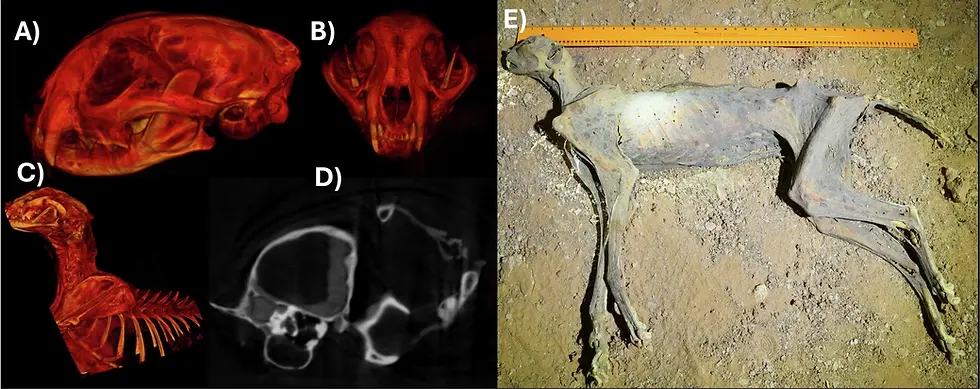
Figure 2:
A, B Radiographic images 3D virtual reconstructions for the skull, C Soft tissues in the cranium. D Thorax of mummy 2. E Mummy one at the discovery site inside the cave.
ThisWildEarth


Comments