The road less travelled: 50 bends to bliss
This article originally appeared in the third edition of ThisWildEarth. See our other publications here.
Triglav National Park (Triglavski Narodni Park), centred on Mount Triglav, and the highest peak in the Julian Alps, might not be the easiest place to reach in Slovenia, but it’s nothing short of spectacular, writes Ilse Zietsman.
Where in the world?
Triglav National Park is nestled between Italy to the west and Austria to the north. Mount Triglav rises almost in the centre of the park. Two major rivers originate here: the Soča, which flows to the Adriatic Sea, and the Sava, which drains into the Black Sea.The park consists of three main sections:
· The Bohinj district with picturesque Lake Bohinj
· The undulating valleys of the Sava Dolinka district
· The Soča district with the dramatic Vršič Pass
Don’t miss
Lake Bohinj is Slovenia’s largest natural lake. It serves as a playground for swimming, hiking, kayaking and paddle boarding, but beyond all the activities, a soul-soothing serenity lingers. The glacial waters, majestic mountain backdrop, panoramic views and tranquillity cast something magical. One moment, we observed a lone horseman arrive and stretch out on the green grass; the next, a paraglider floated down and landed nearby, adding to the surreal charm.
Vršič Pass: Also known as Russian Road, this pass with a series of 50 hairpin bends and 25km of alpine driving, starts in Kranjska Gora, traverses to its top, then descends into the Soča Valley, culminating in the Trenta Valley. The pass is Slovenia’s highest, reaching 1 611m above sea level, and remains open only approximately seven months of the year due to avalanche risk. Check conditions before travelling.
Triglav National Park is a place with deep valleys, soaring mountains and myriad lakes and streams where wild beauty reigns. Wildlife thrives here. Endemic animal species include Alpine ibex, red deer, Alpine marmot, edible dormouse, red fox, wolf, brown bear, and lynx. The flora proves equally special, with mountain species like the white and yellow Julian poppy and the striking Zois’ bellflower found only in this region.
The Vršič Pass is more than just a scenic drive. It comes with a solemn history. During the First World War, more than 10 000 Russian prisoners widened and maintained the road to supply Austro-Hungarian troops. Many prisoners died due to harsh conditions and disease. Tragically, an avalanche later wiped out the prisoners’ lodging and killed 300 more.
You commence your journey along the Vršič Pass at Kranjska Gora, right on the doorstep of Triglav National Park. The locals say fairy tales are alive and well here. It’s easy to believe this in the small town that caters for skiers, mountain bikers and hikers.
Soon after leaving Kranjska Gora, you will reach Lake Jasna (Jezero Jasna) with its shimmering emerald-green water. A statue of Zlatorog, a mythical gold-horned chamois, a species of goat-antelope, stands watch at the entrance. While there, don’t miss the wooden water mill nearby.
As the narrow road climbs, you will pass large gravel flood plains, clumps of trees and diverse forests, quaint mountain huts and snow clinging to distant ridges. It is hard to resist stopping often to look at the view and take in all the natural splendour around you! The park remains dotted with peaceful places to stop, stretch your legs and enjoy a picnic while taking in the views.
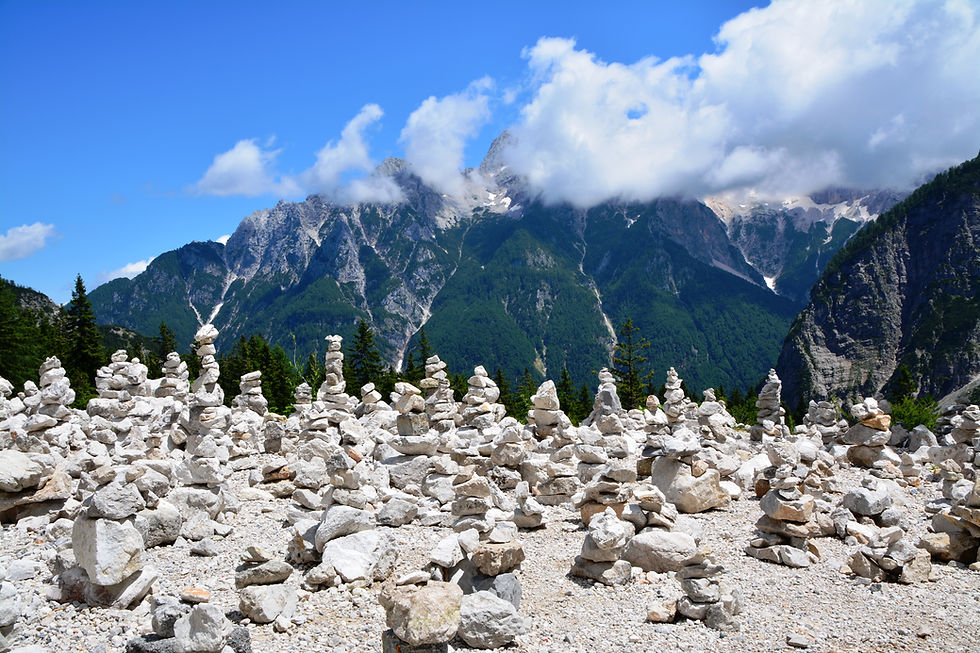
Each hairpin bend of the pass—roughly 25 on the way up and 25 on the way down—is numbered and with the altitude recorded. They can prove quite tight. At bend 17, we spotted dozens of man-made stacked stone towers standing vigil over the deep valley below.
The descent proves as dramatic as the climb. On your way down, a stop along the Soča River with its milky blue-green water—some say emerald green—remains a must-see. The distinctive colour comes from minerals picked up in the Julian Alps, a natural phenomenon that makes it one of Europe's most beautiful alpine rivers.
Triglav represents not just a national park, but a wild, wonderful escape into Slovenia's alpine soul. Whether you are here for the outdoor adventure, the history, or the sheer beauty, one thing remains certain: you'll leave with your spirit lifted and your camera full.

ThisWildEarth


Comments