A walk with the golden ancients
The ancient gold trading city of Thulamela in the northern Kruger National Park changes the narrative of South Africa’s history. Dubbed South Africa’s best-kept archaeological secret, Bridget Hilton-Barber shares the story of this civilisation that flourished for 400 years between the 13th and 17th centuries.
South African history tends to start in the Cape with the arrival of the settlers or the making of the Zulu Kingdom in the 1800s. “But what if the story of South Africa’s history begins instead, here in the Pafuri triangle in northern Kruger?” asks renowned historian Professor Peter Delius, who has been researching Thulamela and its trading system.
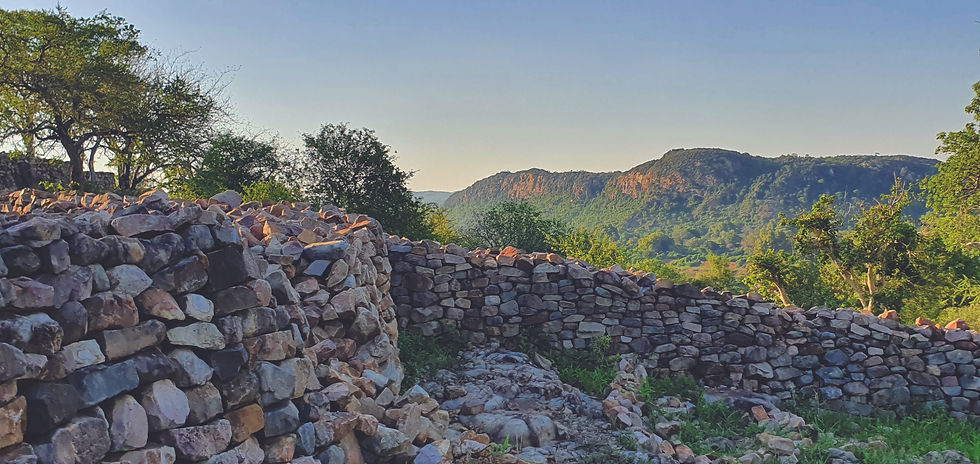
It is a late golden afternoon, and we stand atop Thulamela hill, overlooking the valley of the ancients. We are deep in the heart of the wild, near the confluence of the Limpopo and Luvuvhu Rivers. We climb up a steep, stony path past a series of reconstructed stone walls to get to these hillside ruins that were once a royal citadel.
There is great majesty here. It is not just the extraordinary views of the floodplain below, dotted with baobabs and herds of browsing elephants. It is also the powerful sense of history, the contrast between this vast stillness and learning that right here was once a flourishing kingdom.
From around 1 000 AD, as gold emerged to outrival the ivory trade, Thulamela emerged as a city of skilled goldsmiths, blacksmiths, ivory carvers and businesspeople, a system more sophisticated than we imagined and one that lasted for four hundred years before it declined, due to drought and war. It was not until as recently as 1983 that a park ranger discovered Thulamela, and it was not until the 1990s that the site was excavated and restored on a large scale.
We imagine the soundscape, drums, and the clink of stones and feel the history underfoot. A thousand people lived on this hill and 2 000m below. The people here traded ivory, gold, leopard skins, and rhino horn along the Indian Ocean Trade Route in exchange for cloth, glass beads, porcelain, copper, and bronze. This trade connected Thulamela to Mapungubwe (± 1075 to 1220 AD), a World Heritage Site on the Limpopo River in South Africa, and Great Zimbabwe (± 1100 AD to 1450 AD) in Zimbabwe. Thulamela outlasted both.
We walk amongst the hilltop ruins, first together, then scattering, each person taking a moment to disappear into the majesty. What an incredible part of South African history, with much to learn and explore.
Operated by Return Africa, Pafuri Camp is the springboard for Origin Safari’s remarkable Thulamela experience, a combination of archaeology and history plus wildlife and scenery. Return Africa has just been awarded guiding rights to the Thulamela site, which you may only visit with a guide. Origin Safaris, a tour operator specialising in heritage and archaeology safaris, has recently launched this package.
Pafuri Camp overlooks the Luvuvhu River and features a series of elegant tents reached by wooden walkways, a convivial pool and bar area, and a main meeting, greeting, and eating area, where guests gather, sitting at night around a fire under the stars, one of humanity’s oldest known pleasures.
Humanity evolved on the immense card table of the African savanna, wrote South African anthropologist Robert Ardrey, and there is evidence that our hominid ancestors lived in the Pafuri region around 1.5 million years ago, an early stone tool culture that lasted until about 250 000 years ago before it advanced into the Middle Stone Age. Then it advanced again into Late Stone Age hunter-gatherers some 30 000 years ago.
From 400 AD, Iron Age Bantu pastoralists moved into the area, settling among the local San hunter-gatherers and it was a critical frontier. From around 650 AD, a trading system emerged, linking Pafuri to Chibuene, a site close to modern Vilanculos on the Mozambican coast. From 900 AD, this trading system stimulated the emergence of modern states–most famously at Mapungubwe and Great Zimbabwe but including Thulamela, which has until recently remained a secret.
What is exciting, says Delius, is that the trading system linked to societies 1 500kms to the west in Botswana and 1 000kms south to Natal. Beads and chicken bones helped archaeologists trace key nodes in this trade, which included Madagascar, the Persian Gulf, India, Indonesia, and China.
We close our eyes and listen to imaginary ancient sounds: the morning rooster, a call to prayer, women singing, and water slapping the sides of dhow boats. This is big sky and wide space country. It is a baking 35 degrees Celsius and we sit in the shade of a nyala berry tree, grateful for cold water and the promise of a gin gong at sunset.
For more information, email Origin Safaris info@originsafaris.africa.
This article first appeared in the first issue of ThisWildEarth. Read all our online publications here

ThisWildEarth


Comments