When migration routes turn deadly
We originally published this article in the fourth edition of ThisWildEarth. See our other publications here.
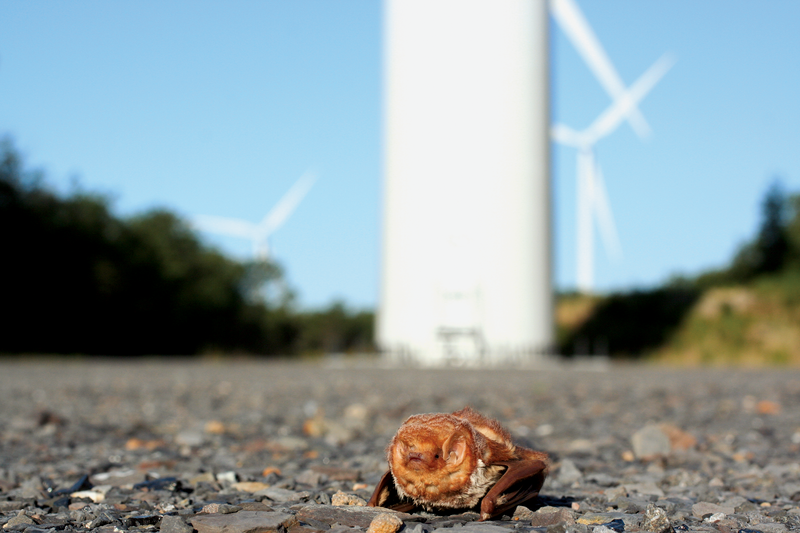
Every autumn, as night falls across North America, countless bats take to the skies to migrate. But for hundreds of thousands of them, the journey ends beneath the spinning blades of wind turbines.
Nearly 80% of deaths are from just three species. Among the worst affected are two familiar tree-roosting species: the hoary bat (Lasiurus cinereus) and the eastern red bat (Lasiurus borealis).
“The relationship between bat migration and fatalities at wind facilities has been difficult to understand. This research reveals an unseen aspect of their migration patterns and moves us closer to understanding how to mitigate this conservation threat,” says Dr Caitlin Campbell, a research scientist at Bat Conservation International.
Bat migration remains a mystery. “Most bats are too small for modern tracking devices and too hard to observe,” Campbell explains. The bats we researched in this study are thought to undertake some of the longest seasonal migrations of any bat species.”
Instead of flying in a straight line as many assumed, researchers discovered that they follow a meandering route, sometimes heading north before turning south again. This pell-mell migration was revealed using a forensic-style technique analysing stable isotopes in fur samples. The bats’ diet leaves chemical signatures in their fur, just like human hair, so this can show where the bat has been.
Why bats make the detour is unclear. Campbell admits it was so unexpected that they spent years refining their approach and double-checking data. However, the discovery opens the door to solutions. “Better strategies to predict when migratory bats will arrive, and detecting them when they are nearby, could help energy facilities briefly curtail activity as bats migrate through. This is the most effective strategy to prevent fatalities.”
The study was a collaboration involving Bat Conservation International, the University of Florida, and the University of Maryland Center for Environmental Science, and other partners.
Blade Speed vs Echolocation Range
Turbine blades: Tips can reach 150–200 mph (240–320 km/h), even when the rotor looks slow from a distance.
Bats: Echolocation is effective only within 4.6–15.2 metres (15–50 feet), depending on species.
Collision risk: The mismatch between high blade speeds and short detection ranges leaves bats little time to evade the blades.


ThisWildEarth


Comments